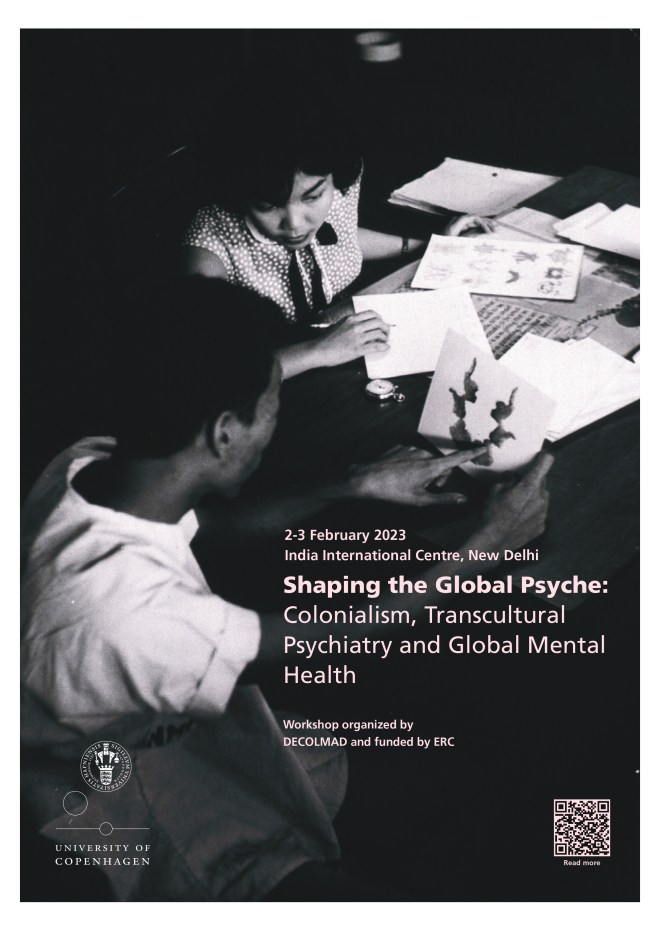
A report produced following the workshop in New Delhi in February, titled “Shaping the global psyche: colonialism, transcultural psychiatry, and global mental health,” could be of interest to Hmadness readers.
“Shaping the global psyche: colonialism, transcultural psychiatry and global mental health” – A DECOLMAD workshop report
By Lamia Moghnieh, Gabriel Abarca-Brown, Shilpi Rajpal and Ana Antic
This article describes the main debates and contributions of the workshop “Shaping the global psyche: colonialism, transcultural psychiatry and global mental health”. This workshop was organized by the ERC Research Project “Decolonizing Madness” team, Ana Antic, Shilpi Rajpal, Gabriel Abarca-Brown and Lamia Moghnieh, University of Copenhagen, in collaboration with Prof. Aparna Vaidik, Ashoka University, New Delhi. It was held at the India International Center (IIC), New Delhi on the 2nd and 3rd February 2023.
The workshop started from the idea that India has been a supremely important laboratory of research, knowledge production and innovation in mental health. The aftermath of the Second World War resulted in the development of transcultural psychiatry, the shaping of a global psyche and new languages and terminology for speaking about suffering and mental illness. Within this new global order, India was regarded as a model site for investigation and experimentation in both colonial and postcolonial periods. After gaining political independence, India became a vital participant in the rapidly developing global networks of psychiatry and psychotherapy, and it remained an important site of global psychiatric research. Therefore, India has provided a rich entry point to invoke discussions and debates on psy disciplines in the Global South, and on the significance of Global South psy practitioners in the making of post-colonial international psychiatry. Besides, India is an important place from which we can examine the roles played by institutions, experts, and practitioners in negotiating bilateral dialogues between the Global North and South.
In order to address these topics, the workshop “Shaping the global psyche” examined the historical origins and development of the concept of global psyche and the field of global mental health (GMH). It explored the historical, sociocultural and political aspects of the internationalisation of psychiatry; the role of colonial frameworks in the emergence of (post-colonial) transcultural psychiatry and the global psyche; the ways in which psy-disciplines and practitioners co-exist with and/or contest their colonial heritage; the effect and influence of these exchanges on psy understandings of self, culture and the mind; and the role of experts and knowledge producers from the Global South in the making of modern mental health sciences. Besides, it raised questions about how local practices, contexts, and networks shape, change and challenge the universalising language of modern psychiatry; and how Western psy-narratives were negotiated, contested, debated and appropriated in these diverse cultural and geographical locations.
With eight participants who presented their papers and a roundtable event with four local practitioners in India, the workshop welcomed and encouraged transdisciplinary approaches to its core questions, as well as interventions from anthropology, literary studies, mental health practice and medical humanities, among others.
Panel I: Global mental health: Tensions, challenges, and reflexivity
The first panel dealt with the rising challenges and conceptual practices of GMH today, drawing on several ethnographic and historical examples. Alok Sarin (Sitaram Bhartia Institute of Sciences and Research, India) chaired the inaugural panel, inviting the speakers to take into consideration the colonial and often erased history of psychiatry and global mental health.
In her paper entitled: “Contingent universality in Global Mental Health: How techniques of malleability and mutuality make and re-make “mental health””, Doerte Bemme (King’s College London, UK) drew attention to how GMH knowledge production operates at the interstices of universality and contingency. She highlighted two concepts to address this epistemic issue: malleability and mutuality. Malleability describes how GMH actors intentionally keep definitions and intervention pathways open and changeable. Mutuality captures an emergent relational ethos driven by the desire to decolonize the field and to produce knowledge more equitably in global partnerships in ways that recognize and undo power differences and colonial assumptions. According to Doerte, these concepts can help us understand the contingent and relational labor of mental health and accept its messiness.
Then, Claudia Lang (University of Leipzig, Germany) presented the paper “Encoding the global psyche: Digitization, universalism, agency”. In her work, she discussed some of the situated – yet assumed to be universal – assumptions developers make about the psyche, its suffering and healing, and about forms of life in which these digital ‘band-aids’ are used. She explored the hopes for and critiques of digital mental health and AI chat bot therapies as they transform therapeutic encounters and ideas of care, affective empathy, and the political economy of mental health, and enable the rise of new therapeutic entrepreneurs and technologists.
In the last turn of this panel, Manuel Capella (University of Guayaquil, Ecuador) presented the paper “Necropolitics and the limitations of hegemonic mental health ideology: Making sense of the past to re-imagine the future”. In this work, he provided a critique of GMH language from Ecuador, exploring how everyday communal experiences, practices and approaches to the rising violence challenge the hegemonic psy language of mental health. This research uses the concept of necropolitics –diverse ways through which power creates death-worlds and destroys entire communities– as an analytical lens to re-imagine a more political and ethical mental health care for communities affected by violence.
Panel II: Therapeutic alternatives: Local concepts and challenges to the global psyche
Sanjeev Jain (National Institute of Mental Health and Neurosciences, India) chaired the second panel, delving into the local therapeutic landscape that sometimes poses challenges and obstacles to the making of global psyches.
Anjana Bala (London School of Economics, UK) presented the paper entitled “Divine trauma: Schizophrenia and embodiment in South India”. In an ethnographically intimate paper, she explored how specific encounters with the divine in India can produce disintegrating subjectivities. Although she argued that spirituality and religion are typically understood as therapeutic in mental health practice, she invited the audience to rethink the sacred and the psychiatric realm.
In his paper “Psychiatric rehabilitation between dictatorship and democracy: The case of the “protected commune” inside the El Peral Hospital, 1983-1989”, Cristian Montenegro (University of Exeter, UK) described the “Protected Commune” (PC) initiative, an experiment that aimed to create a town within a Chilean psychiatric asylum during the country’s oppressive military dictatorship. The initiative served as an experimental space to test ideas of autonomy and normality, while also anticipating the problems and paradoxes that the concept of “community” would create when democracy returned and “community mental health” became the new official language of mental health policy, in 1990.
Panel III: Localizing the global psyche: Psychiatric standardisation and reform in India
The third panel, chaired by Amar Farooqui (University of Delhi) takes colonial India as a rich case study for the making of global psyche and mental health.
Sarah Ann Pinto’s (Social Wellbeing Agency, New Zealand) paper “Carrying on with “common-sense”: Rebuffing reform in Bombay´s Lunatic Asylum, 1894-1933”, focused on the role of intra-professional rivalries between specialist and non-specialist superintendents in thwarting asylum reform. While non-specialists (superintendents who held asylums as an additional charge) preferred to treat patients in a “common sense” way of attending to patients, their counterparts – the specialists (superintendents of central asylums) wanted to remodel asylums based on European and American lines. This transition, they hoped, would legitimize their profession and distinguish them from their non-specialist counterparts. Reform ultimately paid the price for their rivalry.
Shilpi Rajpal (University of Copenhagen, Denmark) presented her paper entitled: “Psychiatry, mental hygiene and colonisation in British India”. She worked on the history of mental hygiene in India and its relation to the emergence of global mental health. Shilpi focused on how the mental hygiene movement shaped specific understanding of the nuclear family, motherhood, and childhood, triggering several social, political, and moral frictions and conflicts in colonial and postcolonial India.
Panel IV: Globalising psychoanalysis
A morning heritage walk in Humayun’s Tomb, led by Dr Swapna Liddle, preceded the fourth panel. The panel, chaired by Gabriel Abarca-Brown (University of Copenhagen, Denmark), invited participants to reflect on how psychoanalysis has become a global body of knowledge, research, and intervention since the beginning of twentieth century. He highlighted that, in this process, psychoanalysis has engaged in multiple ways with other disciplines, local healing systems, and religions in different contexts. Moreover, Gabriel emphasized how decolonial debates on psychoanalysis have put forward radically different perspectives: from a strong objection that psychoanalysis became a part of the colonial project to arguments that psychoanalysis has offered researchers and activists the possibility of a decolonial critique and emancipation.
With the paper “Freud in the colony”, Akshi Singh (University of Glasgow, UK) showed how psychoanalysis was practiced in colonial India in the early twentieth century. Based on Paul Preciado´s essay titled “Can the monster speak?” Akshi drew attention to the potential analogies between patriarchal and colonial foundations of psychoanalysis and the history of psychoanalysis in India. She focused on the history of colonial experiments with psychoanalysis in Quetta, Calcutta, and at the Pitt Rivers Museum in Oxford. Singh’s paper addressed this history and asked what psychoanalysis would look like if it was read through its colonial histories.
Roundtable: Community and Mental Health: Local Voices and Perspectives
The last event in the workshop was a roundtable chaired by Lamia Moghnieh (University of Copenhagen, Denmark) on community and mental health, featuring local voices and perspectives from practitioners in India. The roundtable speakers were Kavita Arora, Child and Adolescent psychiatrist and co-founder of Children First, Hena Faqurudheen, psychotherapist at Hank Nunn Institute (HNI) and group analyst in training, Neeraj Kumar, trained counselor, public health social worker, expressive art-based therapy practitioner and founder of the Unsound Project, and Sanjoni Sethi, clinical psychologist and therapist working at Orkids foundation.
In her intervention, Kavita Arora discussed her personal journey as a therapist and child psychiatrist in India, addressing the state of psychiatry in India, and the role of the family and society in mental health, where the child and adolescent emerged as a difficult category to cure and treat. She also addressed the challenges of child mental health in India, discussing how a therapeutic emphasis on children’s agency can sometimes be a powerful tool for mental health recovery.
Hena Faqurudheen delved into her work on community mental health and the relationship between group analysis and community organizing in India, highlighting crucial topics such as the building of sustainable and political-therapeutic communities, how to approach so called “incurable” categories of illness like personality disorders, and what it means to work with distress rather than diagnosis.
Neeraj Kumar shared their experience as a psychologist working with Dalit[1] queer clients, addressing the relationship between illness and the social system (religion, class, gender, and caste) and how they manifest in colonial and post-colonial settings, with a view over the healthcare system in India. They also spoke about the process through which a person with an illness becomes “unsound”, and how trans experiences become categorized in psychiatric practice, thereby depriving individuals of their constitutional rights. They highlighted the importance of attending to the legal formation of mental illness.
Sanjoni Sethi discussed the challenges of implementing GMH in India, from the point of view of her work with patients who have attachment related concerns, and children with disabilities. She described the current transition in her practice from intervention to prevention, where she became more mindful of the social and external aspects of mental health, and how sexism, casteism and racism can produce and interact with mental illness. She also spoke about the problems in restricting therapy to a strict biomedical approach and an emphasis on diagnosers and labels that sometimes can leave the practitioner with little room to empathize with clients. She addressed the changes in her own therapeutic techniques, such as learning therapeutic skills from patients. There was a focus on the dynamic spectrum which needs to be explored for therapeutic skills, ensuring an evolving nature.
The roundtable closed with a rich and intimate discussion on several topics, including queerness, mental health and therapy, queer identity formation, the importance of the lived experience, how to build safe and therapeutic communities, how to work as practitioners with ambivalent and confusing categories of self and illness, among others.
Workshop Contributions
The workshop brought together mental health practitioners, activists, and researchers from history, anthropology, and psychiatry, to discuss the field of GMH and the concept of the global psyche. Participants described GMH as a field with porous borders, fluid exchanges, and multiple actors involved. The “messiness” of the GMH field – as some participants called it – would reveal a complex field that is constantly evolving. However, in turn, participants highlighted the pragmatism of the field. They pointed out how the spread of mental health programs, technologies, and practices has triggered several frictions and conflicts with local healing systems.
Facing this messiness and pragmatism, participants highlighted the role of history in GMH discussions to put them in perspective. From this viewpoint, they debated how the history of GMH started after WWII and how different initiatives have addressed similar goals since the first part of the twentieth century (e.g., the mental hygiene movement, ethnopsychiatry, among others). Besides, participants emphasized how these initiatives have engaged in multiple ways with political regimes and nation-state values in different local contexts. With this, they focused on the role of experts, therapeutic communities, and practitioners in historical and contemporary terms. For example, they interrogated the psychiatric “de-institutionalization” notion in countries such as Chile, Ecuador, Italy, India, and the UK at different moments during the last fifty years.
Participants also thoroughly discussed the different historical and contemporary dynamics entailed in the making of a universal psyche. They provided critical approaches to reconfiguring the global psyche in local contexts, as illustrated by examples on digital therapeutics, and on the role of the divine encounter in the making of psychic subjectivities and illness. The experience of the practitioners in the roundtable further elucidated the complexities, politics and communal practices that also make, shape, and inform global psyches in mental health practice.
[1] Dalit means a member belonging to the lowest class in the traditional Hindu caste system. The literal meaning is oppressed, broken.
 h-madness