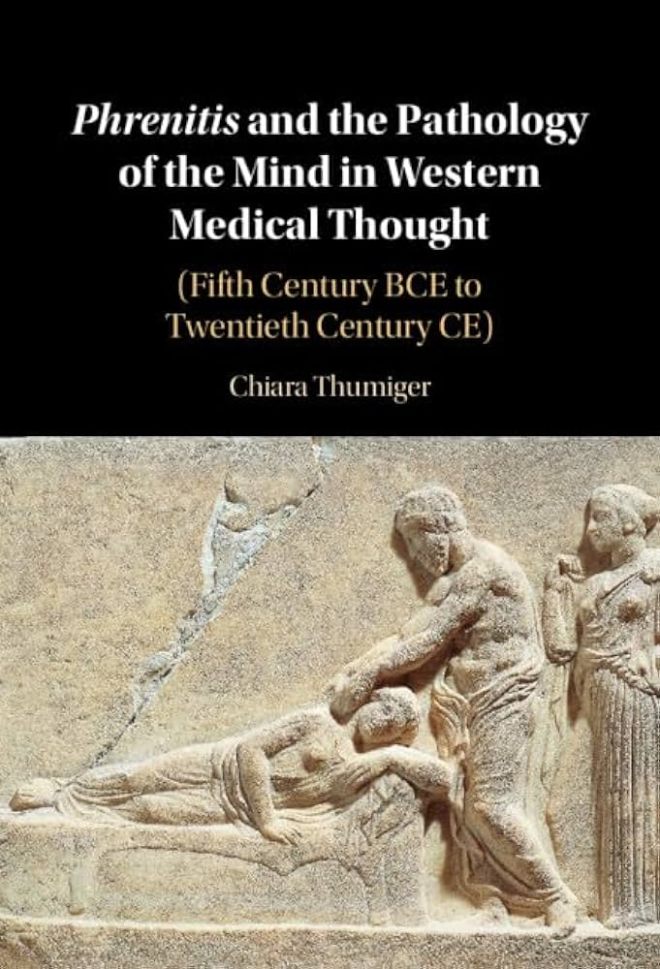
This new book will interest h-madness readers :
Phrenitis is ubiquitous in ancient medicine and philosophy. Galen mentions the disease innumerable times, patristic authors take it as a favourite allegory of human flaws, and no ancient doctor fails to diagnose it and attempt its cure. Yet the nature of this once famous disease has not been understood properly by scholars. This book provides the first full history of phrenitis. In doing so, it surveys ancient ideas about the interactions between body and soul, both in health and in disease. It also addresses ancient ideas about bodily health, mental soundness and moral ‘goodness’, and their heritage in contemporary psychiatric ideas. Readers will encounter an exciting narrative about health, illness and care as embedded in ancient ‘life’, but will also be forced to reflect critically on our contemporary ideas of what it means to be ‘insane’.
Available Open Access here.
 h-madness
This post about Chiara Thumiger’s new book, “Phrenitis and the Pathology of the Mind in Western Medical Thought,” is a fascinating read for those interested in the history of mental illness and its treatment in ancient medicine and philosophy. The comprehensive exploration of phrenitis, a disease frequently mentioned by historical figures like Galen and often used as an allegory by patristic authors, offers a deep dive into the intersection of body, mind, and soul in ancient thought.
What makes this book particularly compelling is its thorough examination of how ancient doctors diagnosed and treated phrenitis, providing a unique window into the past. Moreover, it prompts readers to think critically about how these ancient concepts have influenced contemporary views on psychiatric illness and treatment.
For anyone interested in the evolution of medical thought and the historical perspectives on mental health, this book is a must-read. It echoes some of the themes I explore on my website, psicologo avezzano, where I delve into various aspects of mental health and its treatment. Thumiger’s work is a valuable resource for understanding how our current perceptions of mental illness are rooted in a rich historical context.
Thank you for sharing this insightful post. It’s a significant contribution to the ongoing discussion about mental health and its place in both ancient and modern society.
Best regards,
Floriana De Michele