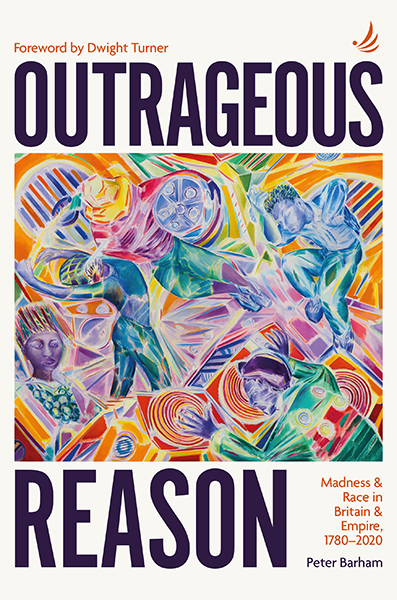
We are very happy to present you a review of the recently published book Outrageous Reason by Peter Barham. This review has been written by Barbara Taylor, Professor Emerita at the Queen Mary University of London.
In 1999 a member of my household heard an altercation in the street near our home. A black man who had been shouting and banging on doors was being bundled into a police van. That man was Roger Sylvester, a thirty-year old Islington Council worker who suffered from mental illness. Sylvester was taken to a nearby emergency psychiatric unit, where he was held down by six police officers and died. An inquest held that he was unlawfully killed but no action was taken against the officers involved. Speaking after the inquest his mother said, ‘all they did was demonise him’: words that could have been spoken by thousands of families of black victims of police violence in Britain today.
Roger Sylvester makes a brief appearance in Outrageous Reason, one of the many demonised black people who populate Peter Barham’s book. Barham is a psychologist, historian, film-maker and mental health activist whose previous publications include the highly-praised Forgotten Lunatics of the Great War (2004). In 1992 he published Closing the Asylum. The Mental Patient in Modern Society, a landmark work which was widely reviewed.
Outrageous Reason is both an intensively researched scholarly work and a fierce polemic. Barham sets out his stall early on:
the idea that we can discuss questions about mental health or madness without engaging with questions of race is faintly ridiculous, if not to say delusory… As I quickly discovered when embarking on the journey that led to this book, in which I try to shed light on the entanglement of mad lives and black lives in a historical terrain where white power has long prevailed, there was plenty to get outraged about.
The journey on which the reader is taken begins in colonial Jamaica during the era of slavery and its aftermath, then over to late 19th c – early 20th c London, on to central Africa and India, then to postwar Britain, concluding with post-imperial Britain and an ‘After’ on the present day. It proceeds largely through case histories: ‘ ‘‘retrieving minor lives from oblivion” as a ‘way of redressing the violence of history’,” Barham puts it, borrowing from the Afro-American scholar Saidiya Hartman (3). These stories vividly demonstrate how ‘the categories and assumptions of classic psychiatry…have in their origins been permeated by the encounter, directly or at a remove, with non-European, or what have been classed as ‘alien’, populations.’ (18) However – a point to which I will return – the alien populations studied here are not always black or non-European. Turning to late 19th c London, Barham examines the fate of ‘poor whites’, the so-called residuum: people whose identities have been ‘morally stigmatised’ by poverty, illness and what social pundits dubbed their ‘uncivilised’ status. White paupers (especially the Irish) were ‘racialised’; in them, unlike the civilised propertied classes, mental illness became an index of their primitive state.
Jamaica: In 1781 a British slave ship (formerly Dutch-owned) enroute to Jamaica threw 132 of its 470 slave ‘cargo’ overboard to save on water supplies. The slaves were insured, so the owners believed – wrongly, as it turned out – they would benefit financially from their deaths. The ship had initially been named the Zorg (or Zorgue – Dutch for care) but an error in repainting the ship’s name made it the Zong. This transition from Zorg to Zong, from ‘care’ to ruthless cruelty, is deployed by Barham as a metaphor for the fate for people regarded as sub-human, disposable.
The enslaved people who eventually made it to Jamaica found themselves in the most prosperous, and probably the most brutal, plantation society. This has been widely studied, as has the ‘scientific’ racist ideology used by planters and their supporters to justify it. (See in particular Catherine Hall, Lucky Valley. Edward Long and the History of Racial Capitalism, 2024). But by telling this history through the story of Henrietta Dawson, Barham provides intimate insights into the intersection between racism and institutional psychiatry at a time when a ‘Zong’ equation between blackness and madness determined the fate of a young mixed-race woman.
The female lunatic asylum in Kingston Jamaica was in the throes of a major scandal about maltreatment of patients when Dawson was admitted on 1858, and again in 1860. Dawson was called to testify to a major inquiry into the asylum set up by the colonial authorities, making her a witness to her own suffering and that of her female inmates.
The story Dawson told the inquiry was vivid, chilling and very moving. She was repeatedly subjected to ‘tanking’, punishment that involved being dunked into a large cistern of water and held down there by 2 or 3 attendants, forced to swallow the water while being alternately lifted and resubmerged until ‘all resistance ceases, or in some cases convulsions have occurred, or life itself has gone’ (48) On Sundays, a favourite day for dealing out this punishment, the water was filthy from the weekly bathing of the patients, usually making the tanked person very ill or even killing them: Dawson witnessed at least two deaths during her periods in the asylum. She left very angry about her experience. Shortly before her discharge she had an altercation with an asylum officer: ‘I got very angry and behaved very rudely. She asked me if I was getting mad again. I said, ‘yes, as long as I am in the madhouse, I will be a mad woman!’ (54)
For Barham, Dawson’s story is emblematic of the treatment of the ‘savage’ and ‘uncivilised’ blacks of Jamaica, as the abject failure of abolition and emancipation to create conditions of equality for freed slaves left its bitter legacies. The final chapter on Jamaica discusses these legacies and those who challenged them from the final decades of the 19th century to the 1960s. The ‘real kickback against the colonial order in Jamaica’, Barham writes, came from Afro-Christianity, in particular from the Revival movement and Rastafarianism, both of which were ‘subjected to remorseless derision as manifestations of a form of religious madness, meriting confinement or punishment in the lunatic asylum, the prison or the house of correction’. The careers of two religious figures – the Revivalist leader Alexander Bedward who was tried for sedition and eventually confined to an asylum; and the Rastafarian Leonard Howell who had many admissions to asylums – provide telling examples of the elision between blackness, oppositional ideals and madness.
Moving over from the ‘mad and poor’ of Jamaica to the ‘poor and mad’ in Britain, Barham writes:
For the ‘respectable’ classes in Britain in the 1880s, there was not much to choose between the ‘white rabble’ who had been demonstrating in London in 1886 under the Reform banner and the black population in Jamaica. Exactly the same questions were posed, and much the same answers returned, about the capacity for self-government among the working classes and the inmates of lunatic asylums in Britain as were being asked about their counterparts in Jamaica. (94)
Like the black enslaved, the ‘uncivilised urban poor’ in London were regarded as a race apart, ‘white but not quite’ as they have been described. (96). The argument is well-rehearsed now but to my mind it is rather parlous: the visible difference of colour surely is a difference that makes a huge difference. The notable, sometimes violent, racism of many poor whites in the US and Britain is a sharp reminder of the prerogatives of whiteness even among those for whom its advantages may be mostly imaginary.
Alice Rebecca Triggs was a white domestic servant who contracted venereal disease around 1915 for which she was treated in one of the ‘lock wards’ established in Poor Law infirmaries to treat paupers with sexually transmitted diseases. She was assumed to be a prostitute and labelled as such, although Barham suspects the VD was rather the results of casual liaisons. After 10 months she was said to have ‘lost her reason’ and was sent off to Colney Hatch Asylum in north London where she was diagnosed with ‘Moral Imbecility’ – a controversial category that was often applied to transgressive women. She was later transferred to Napsbury Asylum from which she was discharged at the end of 1916. Thereafter she went back and forth from domestic service to asylum admissions until in December 1920 she went back to Napsbury under a compulsory detention order where she remained until her death in 1962.
Why was Alice Triggs treated in this way? For the answer Barham turns to Elizabeth Bott’s classic study of Napsbury, in which she concluded that people detained in the hospital were there for largely social rather than medical reasons. As a ‘poor white’ Alice Triggs, Barham writes, ‘was consigned into the darkness of the psychiatric equivalent of a slave hold’. (118). Is this a proper comparison? Certainly her fate was unconscionable but again, the parallel with the suffering of the black enslaved makes me uneasy. Was she the victim of an ‘ideology of racial whiteness’? Perhaps, but the layering of identity categories seems problematic. While it is certainly true that both whiteness and blackness are historically constructed, in terms that sometimes overlap, they also have very different histories. As Barham himself notes, one of Alice’s sisters was able to emigrate to Australia in 1911 because she was white; an opportunity unavailable to any black woman at the time.
Part Three explores the pathologies of empire. The presiding spirit here is the Martinique psychiatrist and revolutionary, Franz Fanon whose books, notably Black Skin, White Masks (1952), employed psychoanalysis to produce a powerful historical critique of the effects of imperial racism and dehumanization on the human psyche. Barham regards Fanon and other post WWI ‘psychoanalytically-inclined observers’ as ‘opening up new ways of thinking about colonised minds, and providing ammunition for anticolonial thinkers and activists.’ (122) His case studies are a black geologist, R R Racey and Sahibzada Faiz Mohammad Khan (Faiz, or the Waliahad, as he was known), the Mir of Khairpur.
R R Racey was hired for an administrative position in Uganda in 1896. Eastern Africa had many regions led by hereditary chiefs. Racey was tasked with amalgamating small rulerships into a British-dominated ‘coherent mass’. He did this well but there episodes of violence and ‘indiscretions’, and finally he was forced out of office. In 1902 he returned to eastern Africa, this time to Nyasaland, now Malawi. During his tenure there he circulated an extraordinary memorandum declaring himself a spiritualist who had been possessed by many creatures including men and women, white and black. The memo was written with a ‘psychotic intensity’ that was treated as evidence of his insanity. Barham hypotheses that Racey’s previous adversarial relationships with local chiefs might have fueled animosities in him that converted into anxiety about punishment by vengeful spirits. (134) The memo was very well-informed about native spiritual beliefs, turning it into ‘a kind of counter-knowledge that engaged a conception of power that was potentially more powerful than colonial power itself – an entirely different order of power, on a different plane of human existence… a kind of restitutive or reparative narrative’. (135) Racey was invalided out of the service and returned to Canada where he died in 1965.
Faiz Khan was the heir to a kingship in Khairpur, one of the many princely states in India during the British Raj. Colonial authorities accepted the existence of these states so long as their rulers were pliable but retained the right to intervene over questions of rulership. On a visit to England in 1932 Faiz’s behaviour raised serious doubts about his ability to run Khaipur in a manner acceptable to the Raj. His personal habits were described as revolting and disgusting; an investigation into his family history led to a diagnosis of schizophrenia and paranoia. This was later challenged by a British doctor, Guy Wrench, who had studied under Freud in Vienna and been won over to psychoanalysis. Wrench had moved to Karachi in the 1920s believing ‘might find in indigenous Indian culture deeper sources of wisdom than had been afforded him by the narrow outlook of Western science and medicine’. (142) Now, invited to view Faiz’s condition, he discovered no signs of schizophrenia but rather a man placed sharply on the defensive by the his colonial ‘benefactors’. As for Faiz’s paranoia, or persecution complex, Wrench remarked that ‘if the Prince did not believe that he had enemies, and is the subject of intrigue and persecution, I should think him so lacking in natural observation and judgement as to be bordering on the insane’. (143) Faced with this, the authorities solicited another opinion, this time from a psychiatrist of a traditional variety, who agreed with the earlier diagnosis of schizophrenia, citing Faiz’s interest in spiritualism as indicative of his mental instability (144). He was placed in private mental home, apart from his family. When Faiz’s father died he was permitted to succeed as Mir, but only in an honorary capacity. Isolated and miserable, his psychological health declined, although as one sympathetic correspondent noted his treatment was so ‘cruel’ that ‘any sane man would become mad’ with it. (146). Should he be deposed? The evidence was never sufficiently conclusive and he seemed have ended his days quietly in Poona under a guardian.
In the penultimate section of the book we meet Roger Sylvester and a number of other black British men who died at the hands of police and mental health authorities. Winston Rose was a Jamaican-born electrician and amateur boxer who in 1979 and again in 1981 was treated very brutally by police after mental health crises. The 1981 episode ended with his death in an ambulance enroute to hospital. Attending health professionals had failed to intervene. A campaign was mounted which led to an inquest that found Rose had been unlawfully killed; none of the police officers involved were prosecuted.
Orville Blackwood was a young man who suffered from mental illness from his early 20s. In 1986 he ended up in Broadmoor Hospital, in its Special Care Unit (SCU). The culture of the SCU was very restrictive, offering no therapeutic support but only heavy drugging, with patients often pinned down for injections. Staff perceived the Afro-Caribbean patients as ‘big, black and dangerous’ (a phrase used by nursing staff) while the patients unsurprisingly regarded the SCU as a punishment block (171). Blackwood died there in 1991, after being injected with two drugs at three and two times their recommended dose.
Blackwood’s death was soon followed by many others: in July 2012 the campaign group Black Mental Health (UK) published a list of fatalities of mental health service users from the African Caribbean communities in the UK, starting with Winston Rose and including Michael Martin (1984), Joseph Watts (1988), Orville Blackwood, Jerome Scott, Munir Yusef Mojothi and Mark Fletcher (all in 1992), Rupert Marshall and Jonathan Weekes (both in 1994), Newton White, Ibrahim Sey and Veron Cowan (all in 1996), David Bennett (1998), Roger Sylvester (1999), Eugene Edigin (2001), Ertal Hussein, Mike Powell and Tema Kombe (all in 2003), Sean Rigg (2008), Godfrey Moyo (2009), Olaseni Lewis and Colin Holt (both in 2010) and Kingsley Burrell-Brown (2011). There have been many more since. ‘The history of psychiatry and mental health services is scarred by racism…Psychiatry, along with the agencies of the criminal justice system, has played a key role in creating the racist stereotype of the…aggressive violent black male’ (Ian Commins, quoted p 175).
An inquiry, led by Herschel Prins, set up after Orville Blackwood’s death, was highly critical of the care received by Blackwood. The report identified how hospital admissions of black people were more likely to have police involvement, and include detainment and secure care. They were more likely to be diagnosed with schizophrenia and to be given higher doses of medication, and were less likely to receive psychotherapy. However the report assigned no blame, and when Prins returned to Broadmoor in 1998 he found no improvement. In 1917 a black patient at Broadmoor, speaking about the staff there, told an investigator:
You can’t trust these people – they are a law unto themselves –they get away with murder here. If for any reason you cross them, they don’t like you, or they see you as a problem, all they’ve got to do is put it down on paper and it’s on your record. It doesn’t matter that it’s not true, when another colleague reads it, then to them it is true, and so on it goes. It’s only your word against theirs and you know who is going to be believed. (180)
Outrageous indeed. In a January 2024 interview Peter Barham spoke about the ‘long fuse of traumatised memory’ that he had first studied in relation to ex-servicemen from WW1 ‘that catches people unawares’ to repeat over time. The traumatising episodes described in his book can have ‘no satisfactory closure’ as ‘they are still very much alive as sources of continuing critical attention and concern in the present.’ Does he see any signs of hope? Not at a ‘structural level’ because obstacles to change are ‘hard-wired into the system’, but at the same time ‘increasing numbers of people’ are ‘challenging and resisting the dominant culture’ and discovering in African world-views radical ideals of hope and renewal. The imperative is to recognise the interdependency of human beings: the ‘philosophy of Ubuntu, ‘a person is a person through other persons’. (British Psychological Society, Jan 2024) Despite all, he remains ‘a hopeful traveller’ through our changing times.
But reading Barham’s book along with recent studies of the treatment of black people in the British mental health system it is hard to feel any optimism. Today even though black people make up just 3% of the general population, 16% of restricted patients in mental care facilities are black. Most restricted patients are transfers from prison and 13% of people in prison are black, but this alone is unlikely to explain the percentage held in secure hospitals. In January 2023 the Guardian reported that black people are four times more likely than white people to be held under Compulsory Treatment Orders: eight times higher than in 2018.
In 2021 the Royal College of Psychiatrists (RCP) issued a robust response to a report by the government’s Commission on Race and Ethnic Disparities (CRED), which had concluded that structural racism does not exist here in the UK. The RCP stressed that the CRED report ‘failed to take notice of the compelling evidence that racial disparities in health, and particularly in mental health, are driven in large part by social factors which are structurally determined’. Yet, as Barham observes, ‘at more informal levels…the impression is that, in time-honoured British and colonial fashion, the profession does its level best to ignore discomfiting realities, or engages with them only in a rather perfunctory and selective fashion, remaining silent on what it means to be white.’ A 2021 social history of psychiatry and mental health in Britain from 1960 to 2021 (Mind, State and Society, G Ikkos and N Bouras, eds) has one chapter on racial issues in which Doreen Joseph, a black teacher and mental health survivor and trainer, shows how ‘the official mind of the state has mostly trampled roughshod over the…needs of black and minority ethnic communities’ (203) Otherwise the volume is ‘silent on the legacies of empire’.
The final case history in the book is that of Colin King, a black mental health survivor, activist, researcher and social worker. King writes of his experiences:
From the age of 17, I was locked and beaten in a padded cell, subjected to ECT, ECG, a cocktail of medication, OT, discharge, and re-admission. I felt like an alien, I had justified my own perception that my mind was disordered. I felt the pain of being a compulsory admission, medicated, and mistreated by a Mental Health Tribunal. They told me I was mad, gave me written section forms that denied my release from the slavery zones of mental illness. I was locked on a ward, drenched in my own faeces and urine, communicated to by nurses, social workers, and consultant psychiatrists as if I was inferior. I felt my dead tongue, my shivers, my bloated stomach that reduced me to a deadness. I could sense fear in the behaviour of white professionals. I saw how they activated the stereotypes of my past in their minds. They told me I was dangerous, unpredictable, dysfunctional, and angry. I felt I had become a caricature to a legislation that repressed me and criminalised me. https://www.mind.org.uk/information-support/your-stories/my-experiences-on-both-sides-of-the-mental-health-act/)
In a March 2021 article for Lancet Psychiatry King condemned the Mental Health White Paper as ‘not only a white paper, but a paper characterised by whiteness’ making use of ‘such neo-liberal terms as choice and autonomy’ while at the same time supporting the use of Compulsory Treatment Orders which are used so disproportionately on black people, especially black men, and making no use whatsoever of Human Rights legislation (1998), the Care Act, 2014, and the Mental Capacity Act (2005). In a March 2021 workshop King argued that the White Paper portends ‘the most dangerous legislation implemented in English society in the past 200 years.ng now places his hope in ‘co-production’ – a form of health service development entailing collaboration between providers and service users aiming at ‘giving patients back their power’. This is clearly an ambition to be strongly supported, by white patients as well as those from black and ethnic minority backgrounds. And if the racialised present produces a pessimism of the intellect, an optimism of the will such as King’s and other black survivor activists is ever more essential.
 h-madness