Dear H-Madness readers,
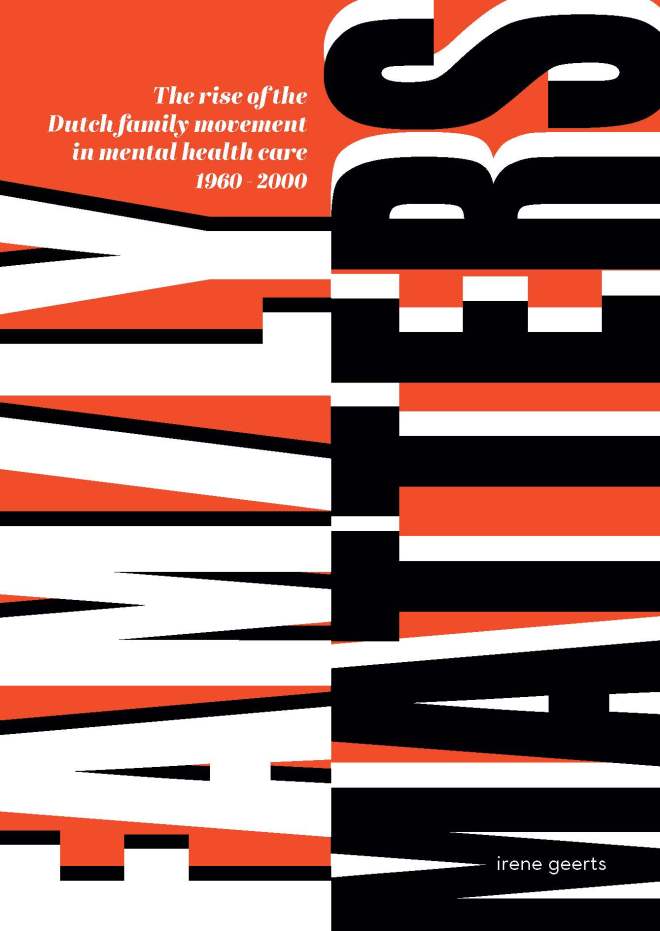
The book The Rise of the Dutch Family Movement in Mental Health Care (1960–2000), by Irene Geerts, based on her doctoral dissertation at the Open University in the Netherlands, may be of interest to you. Please find above the abstract of the book as well as practical information on how to obtain a copy.
“Family Matters examines the emergence and development of the Dutch family movement in mental health care from the 1960s to the early 2000s. Until the 1980s, relatives of people with severe mental health problems were largely excluded from contact with Dutch mental health services, despite often bearing primary responsibility for care.
The study traces early mutual support and activist initiatives of family members in mental health care back to the 1960s, including Al-Anon (1961) and the Pandora Foundation (1964), both operating under conditions of stigma and anonymity. During this period, the biomedical model dominated Dutch psychiatry. Around 1970, the first self-organisation of mental health service users, the Cliëntenbond (Clients’ League), emerged. It represented all clients, as its founding members started calling themselves: (former) psychiatric patients and, initially, close relatives and friends who were informal caregivers. The league became leading in the Dutch countermovement that was inspired by anti-psychiatry.
The social explanatory model of anti-psychiatry, however, often blamed family members – particularly mothers – for causing mental health problems, leading to the systematic exclusion of relatives from care decisions. This exclusion intensified in the early 1980s when constitutional patients’ rights, such as the right to privacy, were interpreted as prohibiting professional contact with families.
In response, between 1980-1985, four distinct family advocacy organizations emerged: LSOVD (for parents of drug addicts), In Perspektief (for Christian families), Ypsilon (for relatives of people with chronic psychosis or schizophrenia), and Labyrint (for all relatives). These organizations shared the goal of demanding recognition for relatives’ problems and stakeholder positions, though they differed significantly in their theoretical orientations and approaches.
The gradual waning of the social model and return of the biomedical model from the mid-1980s onwards reduced family blame and enabled relatives to organize. Government healthcare reforms welcomed family involvement as informal caregivers became essential for community-based care in the context of de-institutionalization, and pushed the family organizations to join forces. It took two decades, however, for them to overcome their ideological differences and start collaborating. In 2006, the organizations joined forces also with clients’ associations in the National Platform for Mental Health Care (now Mind). From there, they established their voice in mental health policy and practice. Although their position remains fragile, the movement continues to work towards improving Dutch mental health care for people with mental health problems and relatives alike.
The book (PDF or hard copy) can be requested free of charge by sending an e-mail to irene.geerts@ou.nl.”
 h-madness